Descriptive study of hospital morbidity in a Public Health Unit from Alagoas, 2020–2024
DOI:
https://doi.org/10.33448/rsd-v15i4.50902Keywords:
Epidemiological profile, Health information systems, Morbidity.Abstract
Epidemiology is an essential science in health services. Health Information Systems (HIS) contribute both to data collection and monitoring of diseases and health problems, as well as to the direction of public policies and allocation of resources. In this context, the Hospital Information System (SIH/SUS) acts as an important administrative and epidemiological tool within the SUS. This study aimed to analyze hospital morbidity in a public health unit in the state of Alagoas from 2020 to 2024. This was a descriptive and cross-sectional study, with data collected from the SIH/SUS system – DataSUS – and analyzed using descriptive statistics based on absolute and relative frequencies. There was a higher prevalence of hospitalizations in males, in individuals of mixed race, and in the age group between 60 and 69 years. Non-communicable chronic diseases and external causes were predominant. Hospital morbidity data are fundamental as they provide information for evidence-based decision-making, thus supporting the public healthcare system.
References
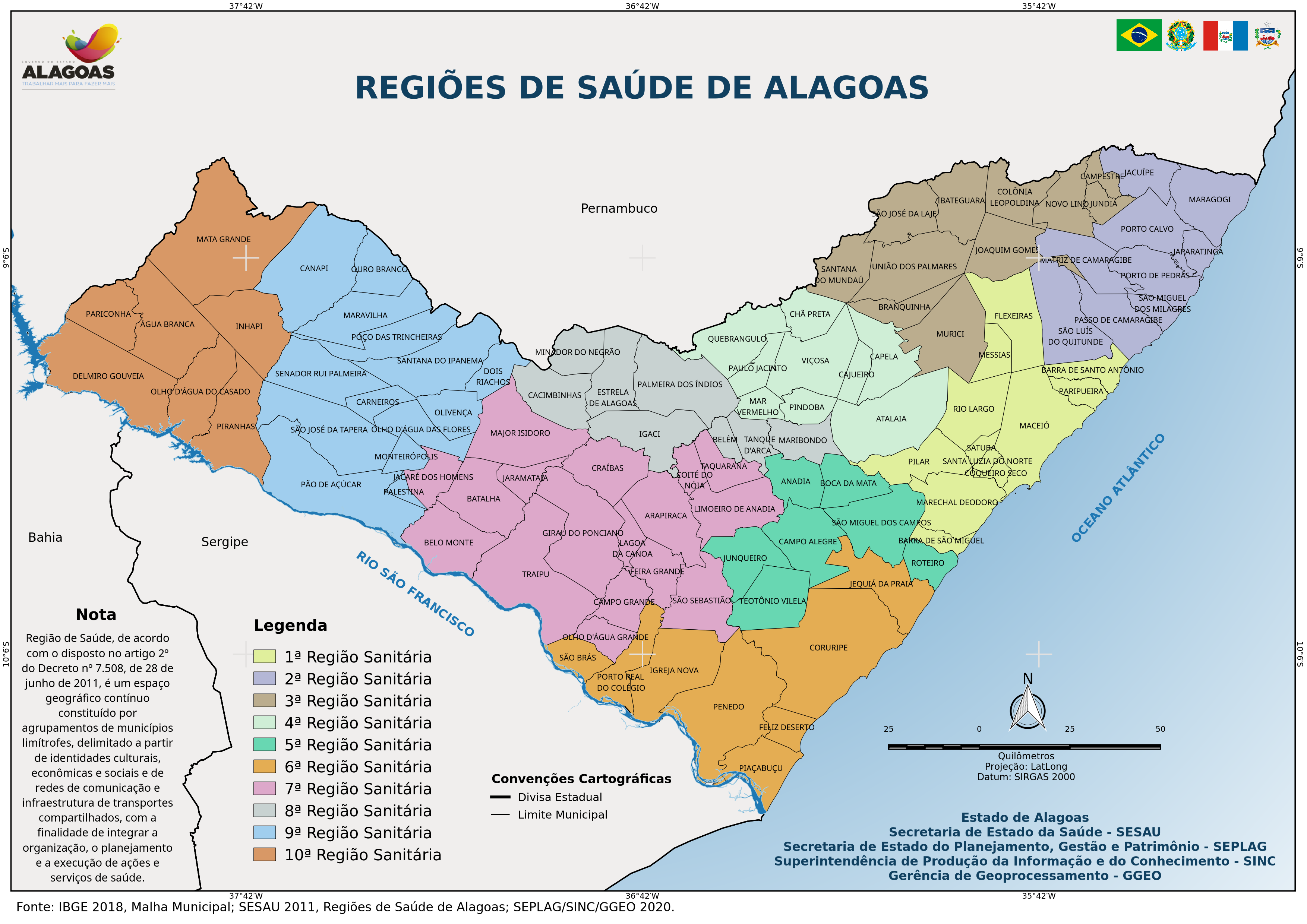
Alagoas. Governo do Estado de Alagoas (2026) Regiões de Saúde de Alagoas (2a Edição) - 2020. https://dados.al.gov.br/catalogo/dataset/9043be4d-35d0-4ce8-8732-84d452681753/resource/dad93c03-011e-4336-86d7-d8cfbab17010/download/regioesdesaudeal.png
Andrade AO et al (2023). Hospitalizations in Brazil according to National Health Survey estimates, 2013 and 2019. Rev Saúde Pública, 57, 73. https://doi.org/10.11606/s1518-8787.2023057004395
Barreto ML (2002). Papel da epidemiologia no desenvolvimento do Sistema Único de Saúde no Brasil: histórico, fundamentos e perspectivas. Rev bras epidemiol, 5, 4-17. https://doi.org/10.1590/S1415-790X2002000400003
Brasil. Ministério da Saúde (2026). Morbidade Hospitalar do SUS (SIH/SUS) – DATASUS.
https://datasus.saude.gov.br/acesso-a-informacao/morbidade-hospitalar-do-sus-sih-sus/
Domingues RMSM et al (2024). Estudo de validação das internações obstétricas no Sistema de Informações Hospitalares do Sistema Único de Saúde para a vigilância da morbidade materna: Brasil, 2021-2022. Epidemiol Serv Saúde, 33. https://doi.org/10.1590/S2237-96222024v33e20231252.pt
Freitas LA de et al (2026). Análise de internações hospitalares por causas externas no Brasil entre 2015 e 2024. Bioethics Archives, Management and Health, 6 (1), 186-200. 10.61223/biamah.v6i1.105
Freitas CM de et al (2023). Observatório Covid-19 Fiocruz - uma análise da evolução da pandemia de fevereiro de 2020 a abril de 2022. Ciênc saúde coletiva, 28, 2845-2855. https://doi.org/10.1590/1413-812320232810.10412023
Góis ALB de, Veras RP (2010). Informações sobre a morbidade hospitalar em idosos nas internações do Sistema Único de Saúde do Brasil. Ciênc saúde coletiva. 15, 2859-2869. https://doi.org/10.1590/S1413-81232010000600023
Gomes HG et al (2017). Perfil das internações hospitalares no Brasil no período de 2013 a 2017. Revista Interdisciplinar, 10 (4), 96-104. https://dialnet.unirioja.es/servlet/articulo?codigo=6772032
Instituto Brasileiro de Geografia e Estatística (2026). Cidades | Alagoas | Panorama. https://cidades.ibge.gov.br/brasil/al/panorama
Júnior N da SV et al (2023). Perfil epidemiológico dos pacientes internados por acidente vascular cerebral no Brasil. Brazilian Journal of Implantology and Health Sciences, 5 (5), 361-369. 10.36557/2674-8169.2023v5n5p361-369
Junior E da CQ, et al (2022). Perfil das internações hospitalares com caráter de urgência no estado de Alagoas entre 2015 e 2019. Brazilian Journal of Health Review, 5 (3), 11247-11267. 10.34119/bjhrv5n3-273
Koike M (2025). DataSUS: Uma Ferramenta Essencial para a Saúde Pública no Brasil. Arq Bras Cardiol, 122. https://doi.org/10.36660/abc.20250123
Loch MR et al (2025). Epidemiologia na Revista Ciência & Saúde Coletiva: análise do ano de 2024. Ciênc saúde coletiva, 30. https://doi.org/10.1590/1413-81232025309.12342025
Medeiros KR de et al (2005). O Sistema de Informação em Saúde como instrumento da política de recursos humanos: um mecanismo importante na detecção das necessidades da força de trabalho para o SUS. Ciênc saúde coletiva,10, 433-440. https://doi.org/10.1590/S1413-81232005000200021
Oliveira TI de et al (2022). Morbidade hospitalar das internações por urgências clínicas. Revista Enfermagem Contemporânea, 11, 4434-e4434. 10.17267/2317-3378rec.2022.e4434
Organização Mundial Da Saúde (2026). Health Information System. https://www.afro.who.int/health-topics/health-information-system
Organização Pan-Americana Da Saúde (2025). Sistemas de Informação em Saúde. https://www.paho.org/en/topics/health-information-systems
Pereira et al. (2018). Metodologia da pesquisa científica. [Free ebook]. Editora da UFSM.
Risemberg, R. I. C., Wakin, M., & Shitsuka, R. (2026). A importância da metodologia científica no desenvolvimento de artigos científicos. E-Acadêmica, 7(1), e0171675. https://doi.org/10.52076/eacad-v7i1.675.
Santos MAS et al (2015). Tendências da morbidade hospitalar por doenças crônicas não transmissíveis no Brasil, 2002 a 2012. Epidemiol Serv Saúde, 24, 389-398. https://doi.org/10.5123/S1679-49742015000300005
Shitsuka, R. et al. (2014). Matemática fundamental para tecnologia. (2ed). Editora Érica.
Downloads
Published
Issue
Section
License
Copyright (c) 2026 Adriana Dayse Rocha Pinheiro Peixoto, Laysa Lindaura Lau Rocha Cordeiro, Anna Lara Rocha Pinheiro Peixoto, Nancy Borges Rodrigues Vasconcelos

This work is licensed under a Creative Commons Attribution 4.0 International License.
Authors who publish with this journal agree to the following terms:
1) Authors retain copyright and grant the journal right of first publication with the work simultaneously licensed under a Creative Commons Attribution License that allows others to share the work with an acknowledgement of the work's authorship and initial publication in this journal.
2) Authors are able to enter into separate, additional contractual arrangements for the non-exclusive distribution of the journal's published version of the work (e.g., post it to an institutional repository or publish it in a book), with an acknowledgement of its initial publication in this journal.
3) Authors are permitted and encouraged to post their work online (e.g., in institutional repositories or on their website) prior to and during the submission process, as it can lead to productive exchanges, as well as earlier and greater citation of published work.